
Finding an apartment in Japan can be incredibly exciting, but for many foreigners, that excitement quickly turns into despair. Between the massive upfront costs and the strict background checks that require a Japanese guarantor, the traditional rental system can feel like an impossible wall to climb.
But there is a savior for your budget: Village House (ビレッジハウス).
With rents starting as low as ¥20,000–¥40,000 per month (Approx. $130–$260 USD), no deposits, and foreigner-friendly screening, it sounds almost too good to be true. Is there a catch?
As an ex-resident who lived in a Village House apartment for 3.5 years, I am here to break down exactly what Village House is, how it works, and the crucial rules you need to know about upfront costs and moving out.
1. The Painful Reality of Japan’s Traditional Rental System
Before we look at Village House, you need to understand why it is such a game-changer.
In most Western countries, moving into a new apartment only requires a Security Deposit (usually 1–2 months of rent) and your First Month’s Rent. However, Japan’s traditional system is packed with unique hidden fees that can feel quite shocking to expats:
- Shikikin (敷金 – Security Deposit): 1–2 months’ rent. (Standard, used for cleaning fees later).
- Reikin (礼金 – Key Money): 1–2 months’ rent. This is literally a mandatory “thank you gift” to the landlord. You will NEVER get this money back.
- Chukai-tesuryo (仲介手数料 – Real Estate Agency Fee): Around 1 month’s rent paid to the agent just for showing you the room.
- Guarantor Company Fee (保証会社費用): 0.5–1 month’s rent to a company that guarantees your rent if you default.
Because of this “laundry list” of fees, getting the keys to a standard Japanese apartment often requires paying 4 to 6 times your monthly rent upfront! For a ¥60,000 ($400 USD) apartment, you might need nearly ¥300,000 ($2,000 USD) cash before you even pack your bags.
2. What is Village House and Why is it So Cheap?
Village House completely disrupts this old-fashioned system. They offer renovated, low-cost apartments all across Japan’s 47 prefectures.
The Secret Behind the Cheap Rent
Many foreigners worry that Village House apartments are cheap because they are Jiko-bukken (事故物件 – stigmatized/haunted properties). This is entirely false. The real reason is highly logical:
Previously, these buildings were known as Koyo-sokushin-jutaku (雇用促進住宅), which was public housing built by the Japanese government in the 1960s and 70s to support low-income workers. When the government decided to sell them off, a large investment fund (now managed under the SoftBank Group umbrella) bought thousands of these properties all at once for a bargain price.
They renovated the interiors, rebranded them as “Village House,” and passed those massive savings onto renters. It is a completely clean, corporate business model.
3. Upfront Cost Comparison: Traditional Apartments vs. Village House
Let’s look at how Village House compares to a standard apartment. This table shows why Village House feels much more like the familiar Western system—and is actually even cheaper:
| Fee Type | Standard Japanese Apartment | Village House |
|---|---|---|
| First Month’s Rent | 1 Month | 1 Month (Often ¥0 / $0 with campaigns!) |
| Shikikin (Deposit) | 1 – 2 Months | ¥0 ($0) |
| Reikin (Key Money) | 1 – 2 Months | ¥0 ($0) |
| Agency Fee | 0.5 – 1 Month | ¥0 ($0) (Direct contract) |
| Guarantor Fee | 0.5 – 1 Month | ¥0 ($0) (In-house screening) |
| Total Upfront Cost | 4 – 6 Months of Rent! 😱 | Almost ¥0! ($0) 🥳 |
By cutting out Key Money, Deposits, and Agency Fees, Village House makes it possible to start your life in Japan with just a few thousand yen (under $100 USD) depending on their current signup campaigns.
4. The Move-Out System: Watch Out for the “Catch”
While the initial system feels beautifully familiar and cheap like back home, you must be aware of the rules when it comes to moving out.
⚠️ The Early Termination Penalty
In the West, if you break a lease early, you usually just lose your security deposit. However, because Village House charges ¥0 upfront, they protect themselves by enforcing strict penalties if you stay short-term:
- If you move out within 1 year: You must pay a penalty equal to 3 months of rent.
- If you move out within 2 years: You must pay a penalty equal to 2 months of rent.
💡 The Verdict: Village House is perfect if you plan to stay in your apartment for at least 2 full years. If you are on a short-term working holiday or a 1-year exchange program, the early termination fees might ruin your budget.
🧹 Cleaning Fee Upon Departure
When you eventually move out, you will be required to pay a fixed cleaning fee (usually around ¥1,210 ($8 USD) per square meter). Since you didn’t pay a deposit (Shikikin) at the beginning, this fee cannot be deducted from anything—it will be a direct out-of-pocket expense. However, if you keep the room in normal condition, the fee is very fair and transparent.
5. Other Honest Pros & Cons to Consider
To help you decide if Village House is right for you, here is a quick summary of what to expect based on my 3.5 years of experience:
The Pros:
- Spacious Rooms: For the same price as a tiny, cramped studio room (1K) in the city, Village House offers spacious 2DK layouts (two rooms plus a dining/kitchen area).
- No Guarantor Needed: You do not need a Japanese relative to co-sign your lease. You only need a friend or supervisor to act as an “Emergency Contact.”
- Modernized Interiors: While the outside looks retro, the inside is typically updated with clean floors, modern toilets, and new kitchen counters.
The Cons:
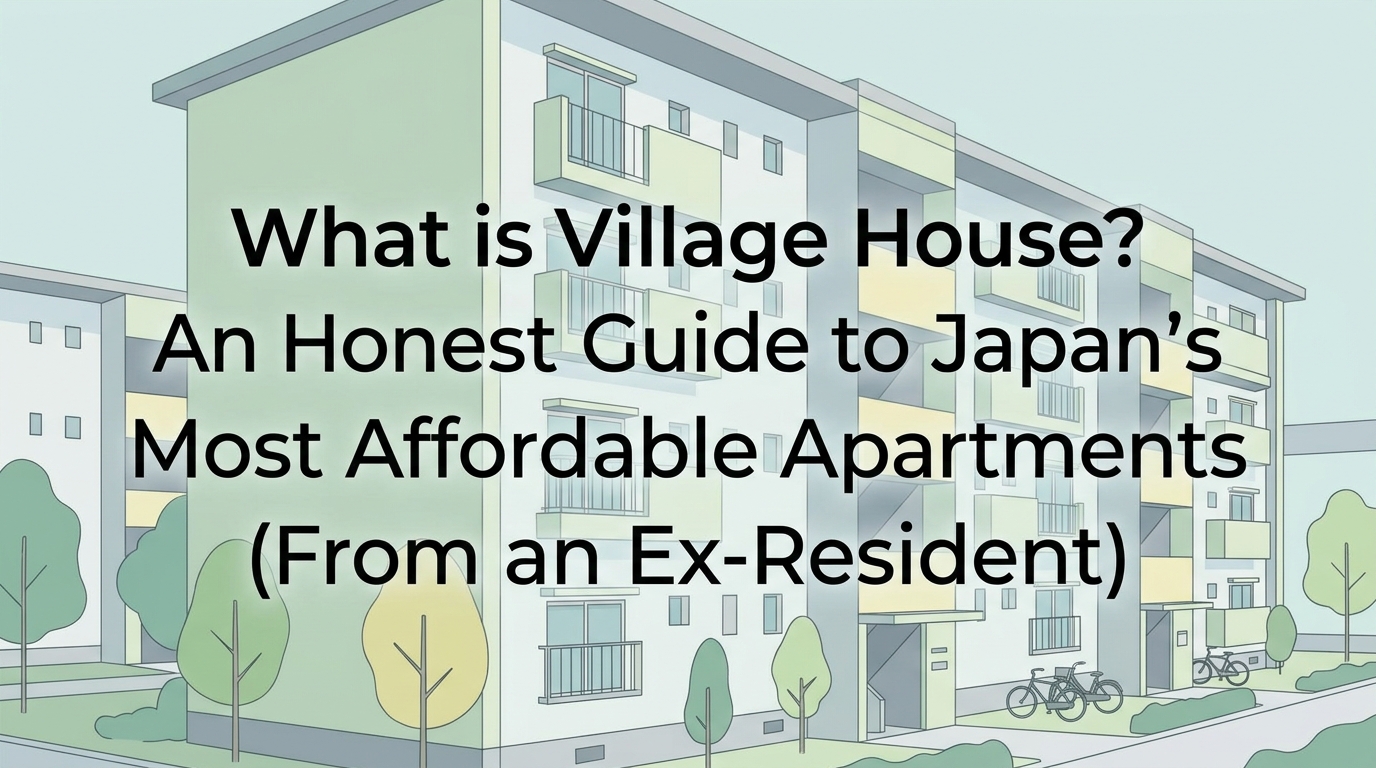
- Retro Buildings (Showa-era Danchi): The buildings are older concrete complexes. Most do not have elevators (if it’s a 5-story building, you might be walking up the stairs).
- Sound Insulation: Concrete blocks noises well, but heavy vibrations (footsteps, doors slamming) can travel through the walls. Japan has a culture of Otaigaisama (mutual tolerance), so being a polite neighbor is key.
- Humidity:** Older concrete buildings trap moisture. You will absolutely need to buy a good dehumidifier to prevent mold during the Japanese rainy season.
Summary: Is Village House Right For You?
Village House is not a luxury high-rise condominium. If you want a brand-new building with a concierge, an elevator, and a trendy downtown location, you should look elsewhere.
However, if you are an ALT, an English teacher, a student, or a digital nomad looking to minimize your living expenses so you can use your hard-earned money to travel, enjoy Japanese food, and save for the future, Village House is easily the best and most reasonable safety net available in Japan.
Just make sure you plan to stay for 2 years to avoid the early contract penalties, and you will have a fantastic, budget-friendly launchpad for your life in Japan!
Ready to Move? Start Your Life in Japan Without the Heavy Upfront Costs!

Feel free to check out available rooms and find your budget-friendly home in Japan: