When you arrive in Japan, setting up a stable internet connection is your absolute lifeline. Whether it’s for checking Google Maps, contacting family back home, or handling remote work as a digital nomad, you need a reliable connection from day one.
However, looking at the retro exterior of a Village House housing complex (Danchi), a common anxiety kicks in: “Buildings here are quite old. Can I actually get decent internet speed here? Is setting it up going to be a stressful Japanese paperwork nightmare?”
As an ex-resident, I have faced these exact worries. The short answer is: Yes, you can get high-speed internet. But in 2026, there is an even smarter hack to completely bypass traditional contracts and installation wait times. In this guide, I will break down your options—including my personal setup where I completely ditched fixed-line broadband for a more flexible mobile solution.
1. Can You Just Use Your Smartphone from Back Home?
Before looking at home Wi-Fi, let’s address your phone. Most expats do not buy a brand-new smartphone upon arriving in Japan; they simply bring their own device. You can do this too, but you must ensure it meets two conditions to work with Japanese networks:
- Your Phone Must be SIM-Free (Unlocked): If your phone is locked to a carrier in your home country (like AT&T or Vodafone), it will reject Japanese SIM cards. Make sure it is fully unlocked before you board your flight.
- Network Frequencies (Bands) Compatibility: Different countries use different radio frequencies. While iPhones work seamlessly worldwide, some region-specific budget Android phones might struggle to catch certain Japanese LTE/5G bands.
2. Option A: Fiber-Optic Broadband (For Speed & Gaming Lovers)
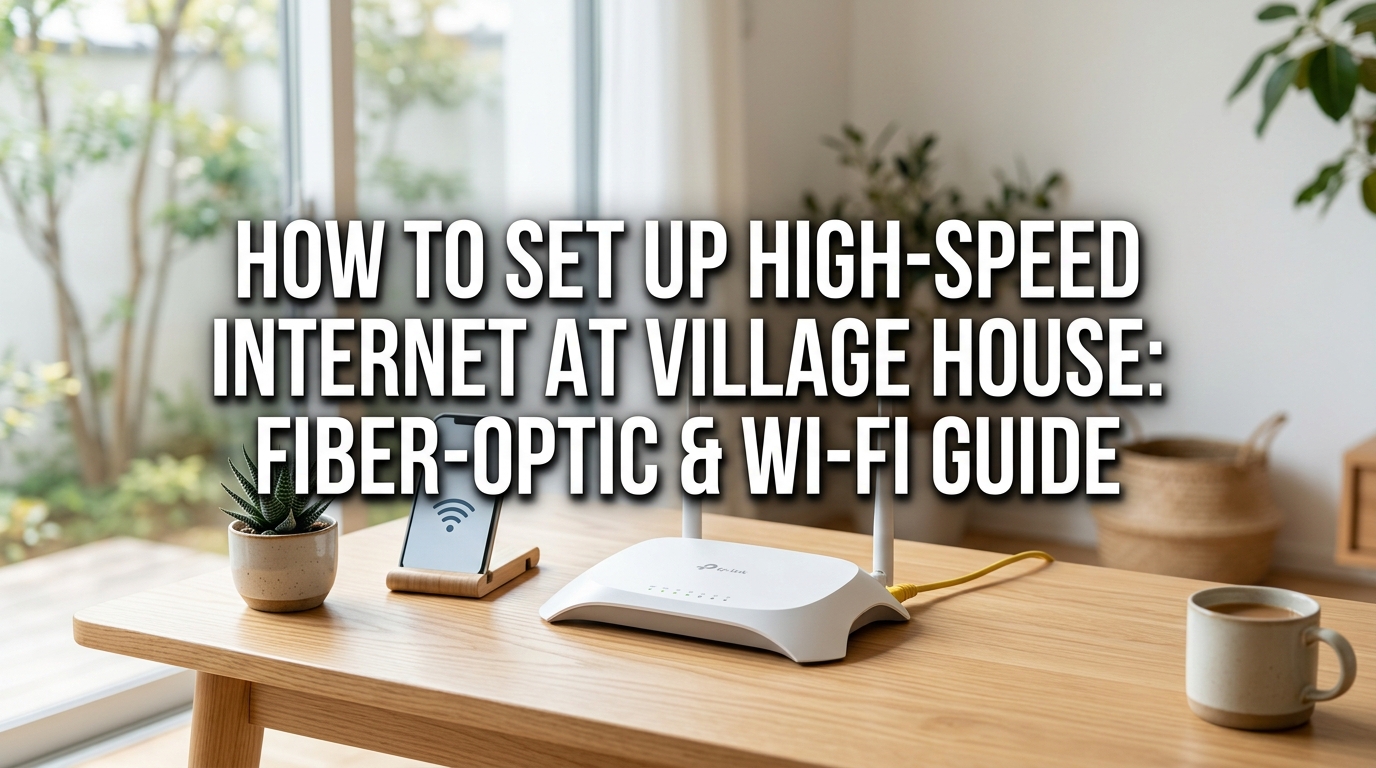
If you are a heavy internet user—such as an online gamer, a software engineer downloading massive files, or someone streaming 4K videos constantly—you will likely want traditional wired Fiber-Optic Broadband (光回線 – Hikari-kaisen).
Old Buildings, Modern Speeds
Don’t let the vintage Showa-era look fool you. Most Village House locations have access to major fiber optic networks (like NTT). You can easily establish a connection capable of up to 1 Gbps directly to your room. I actually had a fiber line installed during my stay and it was rock-solid.
⚠️ The Catch: The Waiting Period
The major downside to fiber optic internet in Japan is time. After you apply, a technician usually needs to come to your building to perform the physical line installation (Kaisen-koji). Because you have to negotiate the schedule (and sometimes get a simple permission confirmation from the management), it can take 1 to 2 months before your line goes active.
💡 What to do? If you choose fiber, you will absolutely need a temporary mobile Wi-Fi device or a generous smartphone data plan to survive your first few weeks.
3. Option B: The Ultimate 2026 Hack — Rakuten Mobile (No Installation Needed)
While I initially used a fiber-optic connection, I eventually discovered a way better method. In this era of rising living costs, paying around ¥4,000 to ¥5,000 every single month for a fixed broadband contract felt unnecessary.
I decided to cancel my fiber broadband completely and switch to using Rakuten Mobile (楽天モバイル) as my solo internet source. It became the ultimate minimalist hack for my life at Village House.
Why Rakuten Mobile is a Game-Changer for Expats:
- Truly Unlimited Data for Cheap: Under the “Rakuten Saikyo Plan,” your monthly fee automatically adjusts based on data usage. If you go over 20GB, it caps out at a flat rate of ¥3,278 (approx. $20–$22 USD) per month for 100% unlimited data. No speed throttling, no hidden limits.
- Turn Your Phone into a Home Router: By turning on your smartphone’s Tethering / Mobile Hotspot feature, you can connect your laptop, tablet, and smart TV to your phone’s network. It is powerful enough to handle high-definition video streaming (like Netflix) and daily Zoom calls effortlessly.
- Zero Waiting, Zero Installation: You don’t have to wait months for a technician to drill holes in your wall or run cables through the building. You get your SIM card, put it in your phone, and your entire home has internet within minutes.
Is it difficult for foreigners to sign up?
Not at all. In fact, Rakuten Mobile is one of the easiest carriers for expats to join because:
- No Language Barrier: Their website is available in multiple languages, allowing you to read and understand the contract terms at your own pace without feeling pressured by a salesperson in a shop.
- Easy Requirements: You only need your Residence Card (Zairyu Card), a passport, and a valid payment method (international credit cards are widely accepted).
- Online Activation: If your smartphone supports eSIM, you can complete the entire process online and start your unlimited internet connection on the same day you receive your residence card!
For those who prefer face-to-face support, Rakuten Mobile also has select stores with multilingual staff or translation tools to guide you through the process.
The Ultimate Budget Combo
By pairing Japan’s cheapest spacious apartments (Village House) with Japan’s most affordable unlimited data plan (Rakuten Mobile), you can cut your fixed monthly living expenses down to an absolute bare minimum. It frees up your hard-earned money to be spent on traveling, dining, and experiencing Japan to the fullest.
Summary: What Should Your Strategy Be?
- If your work depends on millisecond-accurate latency (hardcore gaming or heavy server rendering), apply for Fiber-Optic Broadband as soon as you sign your lease, but prepare a backup pocket Wi-Fi for the first month.
- For the vast majority of expats, ALT teachers, and digital nomads, Rakuten Mobile is the smartest choice. It skips the language barriers of setting up internet contracts, requires no physical construction, and saves you thousands of yen every month.
Check your smartphone’s unlock status before leaving your country, and you’ll be ready to secure your connection smoothly!

Feel free to check out available rooms and find your budget-friendly home in Japan:
 Explore Village House Apartments