
So, your application has been approved, your paperwork is ready, and you are all set to save a massive amount of money on rent and upfront costs. Congratulations! Village House is a fantastic launchpad for your life in Japan.
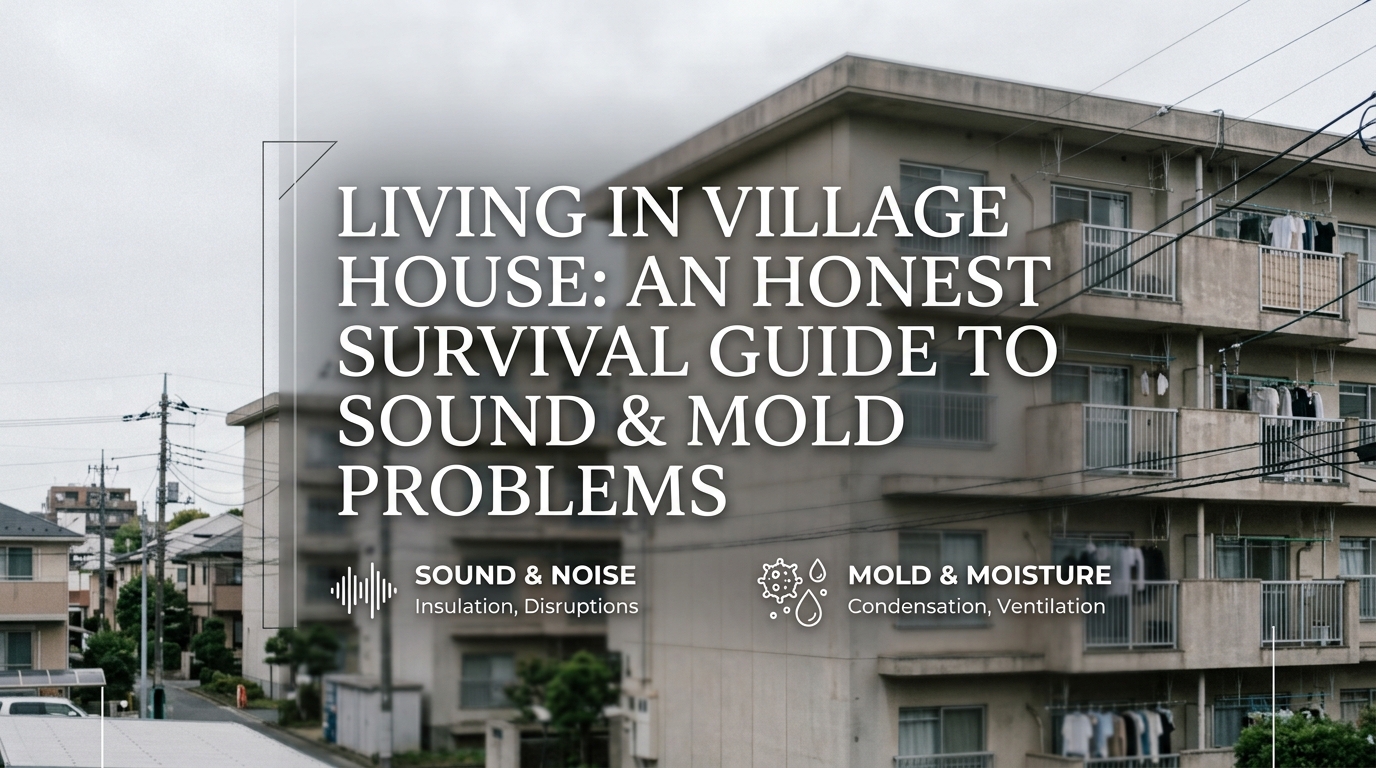
However, before you open your new front door, you need to prepare for the reality of living in a retro Japanese housing complex (Danchi). Because these concrete buildings were mostly constructed in the 1960s and 70s, you will inevitably face a baptism of two notorious challenges: Mold and Noise.
As an ex-resident who spent 3.5 years in a Village House apartment, I’m here to give you the unvarnished truth and the exact survival hacks you need to master your new home.
1. Battle 1: The Japanese “Mold Monster” & Concrete Walls
If you come from a dry country, you might completely underestimate the power of Japan’s humidity. During the summer rainy season (Tsuyu) and even in the freezing winter, moisture builds up rapidly inside concrete structures.
If you leave the apartment unattended without any airflow, you risk waking up to a horror movie scenario: walls covered entirely in thick black mold. Because Village House apartments are made of older reinforced concrete, they trap moisture like a greenhouse.
Your Mold-Fighting Blueprint:
- Buy a Heavy-Duty Dehumidifier (除湿機 – Joshitsuki): Do not rely solely on your air conditioner’s “dry” mode. Investing in a proper standalone dehumidifier is an absolute must-buy in Japan. Run it daily during the summer and winter.
- Keep Furnishings 10cm Away from Walls: Never push your bed, sofa, or wardrobe tightly against a concrete wall. Leave at least a 10-centimeter gap to create an essential airway.
- The Ventilation Routine: Always keep your bathroom and kitchen ventilation fans running after showering or cooking. On clear days, open opposing windows for at least 15 minutes to let the apartment breathe.
- If Mold Appears, Use “Kabi Killer” (カビキラー): If you spot black dots, head to any local drugstore and pick up a red-and-yellow spray bottle named “Kabi Killer.” Spray it, wait a few minutes, and wipe it away. (Warning: It contains strong bleach, so always wear a mask and keep the windows wide open when using it!).
2. Battle 2: Sound Insulation & The Echo of Danchi Life
Many people assume that because a building is made of reinforced concrete (RC structure), it will be completely soundproof. This is a common misconception. While thick concrete is excellent at blocking “airborne noises” (like people talking or television audio), older RC buildings are highly vulnerable to “impact vibrations.” This means sound traveling through solid structures—such as heavy footsteps on the ceiling, a cabinet slamming shut, or a heavy metal front door being closed carelessly—will vibrate directly into your living room.
3 Cheap Soundproofing Hacks (Available at 100-Yen Shops or Nitori):
- Lay Down Anti-Vibration Rugs or Mats: To ensure you aren’t accidentally bothering your neighbors below, place thick rugs or joint mats in high-traffic areas, especially if you tend to walk heavily or have children.
- Apply Door Cushion Tapes (隙間テープ – Sukima Tape): Traditional Danchi metal doors make a loud “BANG!” when closed by the wind. Buy cheap foam cushion tape from a 100-yen shop (like DAISO) and stick it along the door frame to completely absorb the impact sound.
- Use Chair Leg Socks (脚カバー – Ashi Cover): The sound of a wooden chair scraping across the floor rings loudly into the apartment below. Put small fabric “socks” or felt pads on all your furniture legs.
3. The Cultural Concept: The Magic Word “Otaigaisama”
In many Western nations, if a neighbor is making noise late at night, the standard reaction is to immediately call the building manager or the police. In Japan, however, community living relies heavily on a unique cultural mindset known as “Otaigaisama” (お互い様).
Otaigaisama translates roughly to “mutual tolerance” or “we are both in the same boat.” It is the shared social understanding that because we are all living close together in an older building, everyone will inevitably make some daily life noises. You might hear your neighbor’s vacuum cleaner on a Saturday morning, or a door closing slightly too loud in the evening. Instead of getting angry or escalating into a dispute, residents practice a silent contract of patience, knowing that they, too, make noise sometimes.
As long as you do your best to be polite and apply basic cushioning around your room, your neighbors will generally return the same tolerance to you. Knowing this cultural nuance allows you to relax and enjoy your retro home without feeling overly self-conscious.
Summary: A Smart Minimalist Can Overcome Anything
Living in a classic Japanese apartment comes with a few quirks, but mold and noise are 100% controllable with a few thousand yen worth of budget-friendly tools and a solid dehumidifier.
Once you understand how to manage the environment and respect the local neighborhood culture, these minor hurdles fade into the background. You are left with what matters most: an incredibly cheap, spacious home that allows you to fund your adventures across Japan!

Feel free to check out available rooms and find your budget-friendly home in Japan:
 Explore Village House Apartments